
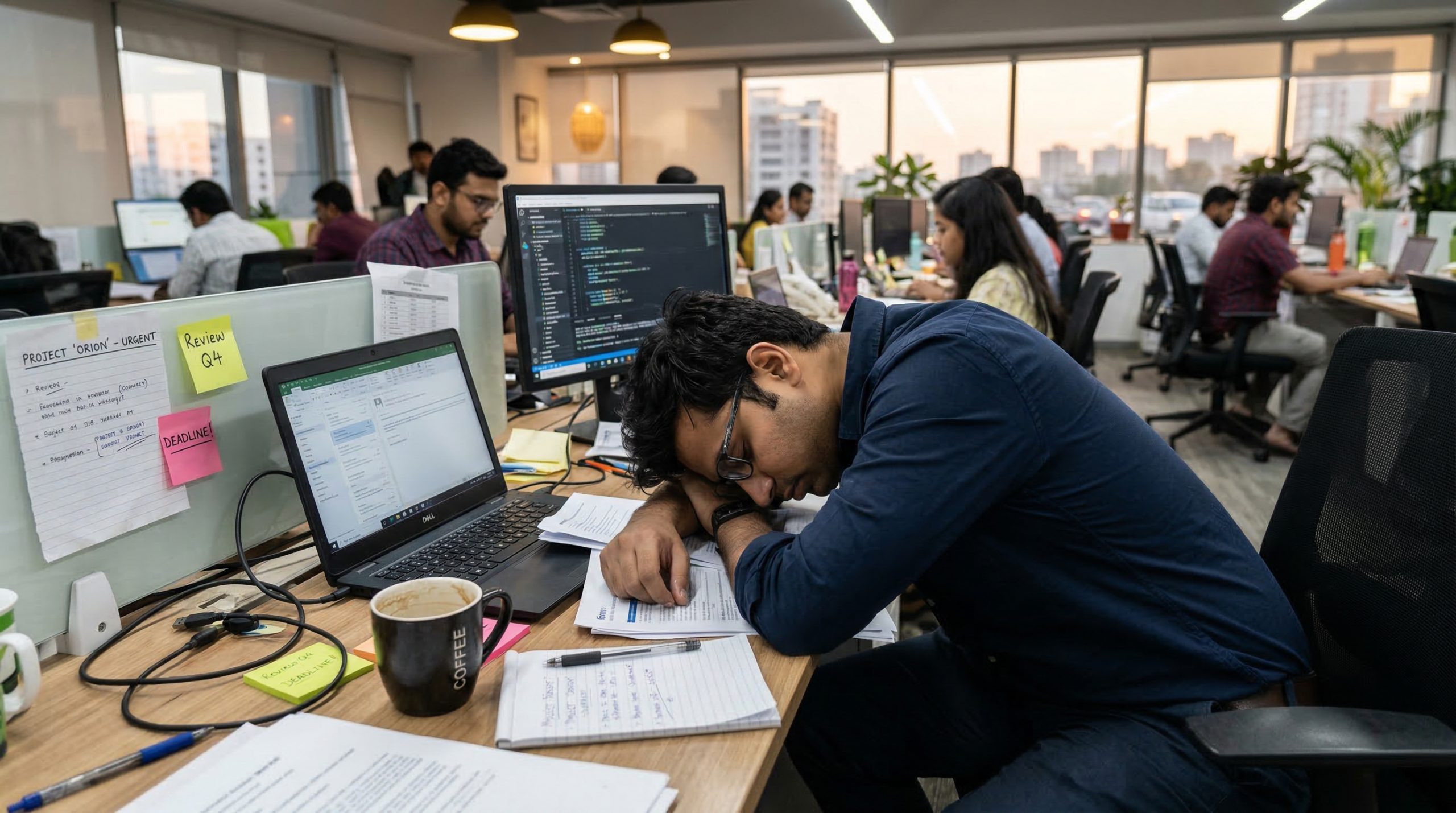
The Afternoon Energy Crash Isn’t About Coffee. It’s About Movement.
It’s 3:15pm. You’re staring at your screen, re-reading the same sentence for the third time. Your eyes feel heavy, your focus is gone, and you’re already mentally negotiating your way to the office pantry for another cup of coffee.
This happens to you almost every day. And every day, you assume it’s normal.
It isn’t. Or rather, it doesn’t have to be.
The afternoon energy crash is one of the most common complaints among desk-based professionals in India. And the near-universal solution is caffeine, sugar, or both. But here’s what’s actually happening, and why no amount of coffee is going to fix it at the root.
What’s Actually Causing the 3pm Crash
Most people assume the afternoon slump is a blood sugar issue, that they ate too many carbs at lunch, or didn’t eat enough, or need a quick sugar hit to get going again. And while nutrition plays a role, it’s rarely the whole story.
The more accurate explanation is this: you’ve been sitting still for six to seven hours, and your body is shutting down in protest.
Here’s what happens physiologically when you sit for extended periods.
Within the first 30 minutes of sitting, muscle activity in your lower body drops dramatically. Your body, sensing that no movement is required, begins to reduce circulation to the extremities. Blood flow slows. Metabolic rate drops. And the muscles that are responsible for keeping you upright and alert, your postural muscles, your core, your legs, go largely quiet.
By hour three, you’re running on significantly reduced blood flow to the brain. Your lymphatic system, which has no pump of its own and relies on movement to circulate, has slowed to a crawl. Waste products that accumulate in tissue during normal cellular activity aren’t being cleared efficiently.
By the time 3pm arrives, you’re not tired because you’ve worked too hard. You’re tired because you’ve barely moved at all. This is movement debt, and your body is collecting.
Why Caffeine Makes It Worse Over Time
Coffee works in the short term by blocking adenosine receptors in the brain. Adenosine is a compound that builds up throughout the day and signals fatigue. Caffeine doesn’t eliminate it, it just temporarily masks the signal.
The moment the caffeine wears off, the accumulated adenosine hits harder. This is why a 3pm coffee often leads to a 6pm crash that’s worse than the original slump, and why it interferes with sleep quality even when consumed hours before bed.
More importantly, caffeine does nothing about the actual problem. The blood isn’t moving. The muscles are still switched off. The metabolic slowdown that caused the crash in the first place continues untouched.
Reaching for coffee every afternoon isn’t a solution. It’s a postponement. And like most postponements, it compounds.
The Indian Desk Worker Problem
This issue hits Indian professionals in a particularly concentrated way.
The average Indian office worker sits for anywhere between 9 and 11 hours a day when you account for the commute, the desk, and the sofa at home. Physical activity outside of structured exercise, what researchers call NEAT, or Non-Exercise Activity Thermogenesis, is chronically low.
Add to this the dietary pattern that most Indian professionals follow. A carbohydrate-heavy lunch, rice, roti, dal, with relatively low protein, consumed quickly between meetings, followed immediately by a return to the desk. The digestive load of a large lunch combined with the absence of any movement afterwards is a near-perfect recipe for a blood sugar spike, a rapid drop, and the cognitive fog that follows.
It’s also worth noting that many Indian professionals who do exercise go to the gym in the morning, which is great, but then spend the next 9 hours completely sedentary. A single morning workout does not undo the metabolic impact of a full day without movement. The body doesn’t operate on a daily balance sheet. It operates hour by hour.
What Movement Actually Does in the Afternoon
Even modest movement, a 10-minute walk, a few minutes of bodyweight exercise, simply standing for a stretch, produces a cascade of effects that no stimulant can replicate.
Circulation resets. Blood starts moving to the brain again. Oxygen delivery improves. The cognitive fog begins to lift within minutes.
Muscle activity resumes. The postural and stabilising muscles that have been dormant re-engage. This triggers a modest but meaningful uptick in metabolic rate.
Blood sugar stabilises. Light physical activity after a meal is one of the most effective tools for managing postprandial blood sugar spikes. Even a 10-minute walk after lunch blunts the insulin response and smooths the energy curve for the hours that follow.
Adenosine clears. Movement accelerates the clearance of metabolic byproducts, including the fatigue-signalling compounds that caffeine only masks.
The result is a second half of the day where you’re actually present, not just physically at your desk, but cognitively available.
The Deeper Problem: Sedentary Life Degrades Muscle Over Time
The afternoon crash is a daily symptom. But the underlying condition builds over years.
Chronic sedentary behaviour, sustained across months and years without adequate resistance training, leads to progressive muscle loss. This process, called sarcopenia when it reaches clinical levels, doesn’t happen only in old age. Research increasingly shows it begins in the early 30s in people who are insufficiently active, and accelerates rapidly in desk-based lifestyles.
Less muscle means a slower resting metabolism. Less muscle means poorer glucose regulation. Less muscle means reduced capacity to generate energy efficiently, which shows up not just as an afternoon crash, but as the kind of persistent, baseline fatigue that makes the whole day feel harder than it should.
This is the foundation most energy interventions miss. You can optimise your sleep, your nutrition, your supplements, and still feel perpetually drained if your muscle health is compromised. Because muscle isn’t just about physical strength or how you look. It’s the primary engine of your metabolic function.
Practical Changes That Actually Help
Break sitting every 45–60 minutes. You don’t need a standing desk or a gym break. Set a reminder. Stand up. Walk to a window. Do 10 bodyweight squats. The threshold for benefit is low, consistency matters more than intensity here.
Walk after lunch. Even 10 minutes. This single habit has a measurable impact on afternoon energy and blood sugar management. If you can make only one change, make this one.
Reduce the carbohydrate load at lunch. A lighter, protein-forward lunch, paneer, eggs, curd, legumes, produces a far more stable energy curve than a heavy rice or roti-based meal. You don’t need to eliminate carbohydrates. You need to balance them.
Hydrate ahead of the crash. Mild dehydration is a significant contributor to fatigue and is frequently mistaken for hunger or the need for caffeine. Most desk workers are consistently under-hydrated. Drink water proactively through the morning rather than reactively in the afternoon.
Build resistance training into your week. Not for aesthetics, for metabolic baseline. Two to three sessions per week of progressive resistance training, even at home, rebuilds the muscle capacity that chronic sitting erodes. Over weeks and months, this shifts the baseline energy level upward in a way that no lifestyle hack can replicate.
The DashFit Perspective
At DashFit, we see the afternoon crash as a signal, not an inconvenience. It’s the body reporting on what’s happening underneath, sedentary hours accumulating into movement debt, muscle health declining quietly, metabolic efficiency dropping year on year.
The professionals we work with are typically in their late 20s to early 40s. They’re not unwell by conventional measures. Their blood reports are broadly normal. They exercise occasionally. They’re not overweight, or if they are, only marginally.
But they’re tired. Consistently, inexplicably tired.
And the first thing we do is assess where their muscle health actually stands, not their weight, not their BMI, but the actual lean mass that drives their metabolism. Because once you understand the baseline, the interventions stop being generic advice and start being a specific plan for a specific body.
The afternoon crash isn’t an inevitability of modern work life. It’s a symptom of a fixable problem.
Start by moving more. Then find out what else your body is trying to tell you.
Think your energy crash might be more than just a bad habit? Start with a DashFit assessment and find out what’s actually going on.