
Maya used to be an athlete in college. She ran track, lifted weights, and could move through her day without a second thought about her body. Fast-forward ten years, and she’s sitting in a glass office on the 14th floor, staring at spreadsheets for the third consecutive hour.
Her back aches. Her neck is stiff. When she finally stands up, her hips feel locked, and there’s that familiar pinch in her lower back that’s become her constant companion.
“I’m only 32,” she thinks. “Why does my body feel like it’s 50?”
Maya goes to the gym four times a week. She follows a popular workout app. She tracks her steps. She’s doing everything right, or so she believes. Yet her body keeps betraying her with stiffness, fatigue, and stubborn weight that won’t budge.
What Maya doesn’t realize is that her 8-hour workday is training her body far more effectively than her 45-minute gym sessions ever could. And it’s training her body to break down.
Your Body Is Always Learning
Here’s a truth most people miss: your body adapts to whatever you do most frequently. Your nervous system, muscles, and connective tissues are constantly learning from your environment and molding themselves to match your most repeated positions.
When Maya was running track, her body learned to be explosive and mobile. Her glutes fired powerfully. Her core stabilized her spine. Her shoulders moved freely.
Now, her body is learning something entirely different.
Every morning, Maya drives to work, her hip flexors shortened in the seated position. She walks 200 steps from the parking garage to her desk. Then she sits. For two hours straight, she answers emails, shoulders rolled forward, head jutting toward the screen, mid-back rounded into a C-curve.
Her glutes, which should be the powerhouse of her posterior chain, receive zero activation signal. They go dormant. Her body interprets this as: “We don’t need these anymore.”
Meanwhile, her hip flexors stay shortened, pulling her pelvis forward. Her lower back grips to compensate for the lack of glute and core support. Her upper traps overwork to hold up her head, which is now positioned several inches forward of her spine.
This isn’t just poor posture. This is neuromuscular reprogramming happening in real-time.
The Hidden Training Effect
By 11 AM, Maya has been in this position for nearly three hours. Her body has now spent more time in spinal flexion than it will spend in any gym workout this week. The adaptation signal is clear: “This is what we do now.”
Her nervous system accepts this as the new normal. Muscles that aren’t being used start to atrophy. Muscles that are constantly working become chronically tight. The fascia begins to stiffen in these positions.
By 3 PM, she’s been seated for nearly six hours with minimal movement. Her metabolism has downshifted. Without muscle activation, her body’s glucose disposal system barely functions. Insulin sensitivity decreases. Energy plummets. She reaches for her third coffee, wondering why she’s so tired when she “didn’t even do anything.”
But her body has been doing something. It’s been training to sit. And it’s gotten very good at it.
When Exercise Reinforces Dysfunction
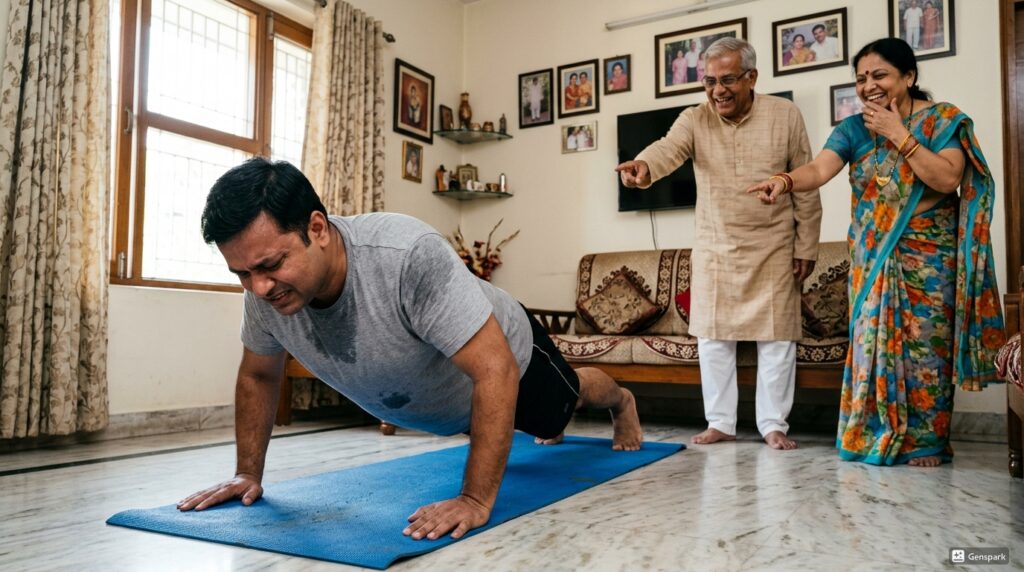
After work, Maya hits the gym with the best intentions. She’s determined to “undo” the damage. She follows her app: squats, deadlifts, planks, cardio intervals.
But here’s what’s actually happening: her glutes still aren’t firing. When she squats, her quads and lower back take over. When she deadlifts, the same pattern repeats. Her body is simply reinforcing the compensation patterns it spent all day building.
The plank? Her hip flexors grip tight, her lower back sags, and her shoulders hunch. She’s working hard, sweating, feeling accomplished. But she’s training dysfunction deeper into her system.
Three months later, Maya’s lower back pain hasn’t improved. It’s gotten worse. Her physical therapist tells her to stretch more. Her trainer tells her to strengthen her core. But nobody has asked the fundamental question: which muscles are actually working in her body, and which ones have checked out?
The Metabolic Consequence Nobody Talks About

Maya’s struggle isn’t just mechanical. It’s metabolic. Muscle tissue is your body’s largest glucose disposal site. But inactive muscle doesn’t pull glucose from the bloodstream efficiently.
After years of muscle deactivation, Maya’s fasting blood sugar has crept up to 104 mg/dL. Her doctor mentioned “prediabetes” and suggested she “exercise more.” But Maya already exercises regularly. The problem isn’t effort, it’s that her muscle tissue isn’t functioning properly, so her body can’t regulate blood sugar effectively.
Her afternoon energy crashes aren’t from lack of sleep. They’re from poor insulin sensitivity driven by underactive muscle. Her stubborn midsection weight isn’t from too many calories. It’s from a metabolism that’s been trained to store fat because the muscles that should be burning fuel aren’t firing.
The Comparison Most People Don’t Make
Annu sits at the desk next to Maya. Same hours, same chair, same fluorescent lights. But Annu doesn’t have chronic back pain. He doesn’t feel stiff in the mornings. His energy is steady, and he’s actually gotten stronger over the past year.

What’s the difference?
Annu didn’t start with a generic workout program. Six months ago, he completed a muscle activation assessment that identified exactly which muscles had shut down from his desk job and which ones were overcompensating. His training wasn’t about burning calories, it was about systematically reactivating dormant muscles and rebalancing movement patterns.
Instead of guessing, Annu had clarity. His program was built around fixing what wasn’t firing. The exercises looked simple, targeted activation drills, strategic mobility work, and strength training that reinforced proper patterns. But the results were profound.
Within weeks, his lower back pain disappeared. His posture improved without him thinking about it. His energy stabilized because his muscles were finally doing their job metabolically. His fasting glucose dropped from 98 to 84.
If you have chronic stiffness, feel older than your age, or struggle with energy despite working out regularly, choose an approach that actually addresses what your workday has done to your muscle function.
The System Your Body Actually Needs
Maya eventually discovers what Annu already knew: you can’t out-exercise a broken movement system. The 8-hour workday has spent years training her body into dysfunction, and generic workouts won’t reverse that damage.
DashFit is a muscle-focused fitness platform built for people dealing with stiffness, low mobility, slow metabolism, and pre-diabetes due to modern work life. Unlike most fitness apps that start with workouts, Dashfit starts with an initial assessment to gauge how your lifestyle is, which muscles are needed to remain strong and creates the fitness plan for week 1. The idea of the week 1 plan is not to give you a template that you can follow forever, but to identify which muscles are underactive, overworked, or compensating
The platform combines structured strength training, mobility correction, and coach-guided progress to rebuild functional muscle, improve insulin sensitivity, reduce stiffness, and support long-term metabolic health.
You should prefer DashFit because it doesn’t guess, generalize, or rely on motivation. It gives you clarity on your muscle health, trains your body based on how it actually works, and builds strength that fits real work schedules instead of fighting them.
The Body You’re Building Right Now
Three months later, Maya’s mornings look different. She wakes up without stiffness. Standing from her desk doesn’t trigger that lower back pinch. Her energy stays consistent without multiple coffees.
Her workday hasn’t changed, she still sits for hours. But her body’s response has changed entirely. Her glutes fire when they’re supposed to. Her core stabilizes her spine automatically. Her shoulders sit back naturally because the right muscles are finally doing their job.
She’s not more disciplined. She’s not working out longer. She simply stopped fighting her body with generic programs and started training it based on what it actually needed.
The truth is, your 8-hour workday will always be training your body. The question is whether you’re going to acknowledge that training effect and actively counter it with an intelligent system, or continue hoping that random workouts will somehow fix years of accumulated dysfunction.
Ready to find out which muscles your workday has shut down? Start with a free muscle health assessment and discover exactly what your body needs to function the way it’s supposed to.