
Walk into any gym, open any fitness app, scroll through any nutrition reel — and the message is the same. Eat more protein. Hit your macros. Get your grams in.
And so people do. They switch to high-protein diets, add protein shakes, swap their snacks, read labels. They do all of this diligently — and then wonder why their body isn’t changing.
Here’s the part nobody is telling you clearly enough: protein does not build muscle on its own. Not even close. And if you are living a largely sedentary life, no amount of protein consumption will save you from losing muscle mass as you age.
What Protein Actually Needs to Work
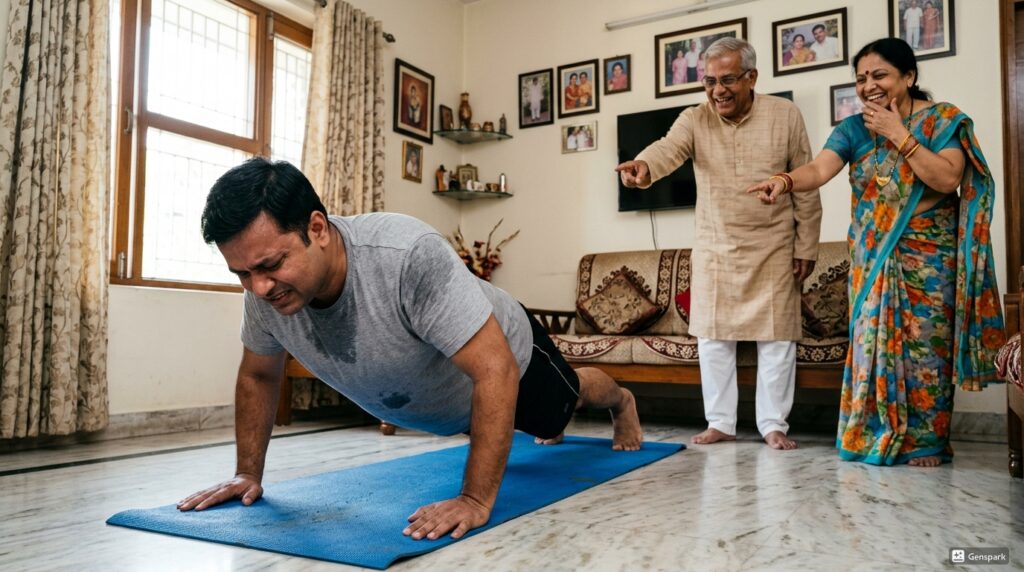
Think of protein as raw material and training as the construction work. You can pile as much raw material on a site as you want — without the work, nothing gets built.
When you train your muscles — specifically through resistance or strength training — you create microscopic damage in the muscle fibres. Your body’s response to that damage is to repair and rebuild those fibres stronger than before. That rebuilding process is called muscle protein synthesis, and that is where protein’s job begins. The amino acids from the protein you eat are the raw material your body uses to carry out those repairs.
But here’s the critical part: the signal to use protein for muscle building comes from the training, not the protein itself. Without that stimulus, your body has no reason to direct protein toward building new muscle tissue. Multiple large-scale studies — including a meta-analysis of over 80 clinical trials — confirm that protein intake leads to meaningful muscle strength gains only when combined with resistance training. Protein alone, without exercise, showed no significant benefit.
So Where Does the Protein Go Instead?
Your body is not wasteful. If you are eating protein but not training, that protein doesn’t just sit idle — it gets redirected.
First, your body uses protein for the many other essential functions it performs daily. Protein is the raw material for enzymes that drive every chemical reaction in your body, hormones like insulin and cortisol, antibodies that keep your immune system functioning, haemoglobin that carries oxygen in your blood, and the constant repair of skin, hair, and connective tissue. These are not small jobs. Your body runs on protein in ways that have nothing to do with muscle.
Once those needs are met, any remaining excess follows a specific metabolic path. The liver strips the nitrogen from the leftover amino acids — that nitrogen becomes urea and is excreted in your urine, which is the “flushing out” part you may have heard about. But the remaining carbon skeleton doesn’t disappear. It gets converted into either glucose for energy, or — if your energy needs are already met — into fat for storage.
This is the part most people don’t expect: excess protein in a sedentary body can contribute to fat gain, not muscle gain. Eating more protein than your lifestyle requires does not get stored as muscle. It gets stored as fat or burned as energy, depending on what your body needs at that moment.
What About Rest Days — Do You Still Need Protein?

Yes — and this is where most people get it wrong in the other direction.
The assumption is: no workout today, so less protein today. The science says the opposite.
Your muscles don’t actually rebuild during your training session. They rebuild after it. Muscle protein synthesis — the repair and strengthening process — stays elevated for 24 to 48 hours following a training session. Research has directly measured this: protein synthesis rates were 50% above baseline 4 hours after a workout, and had more than doubled by the 24-hour mark. The actual construction work happens on your rest day, not in the gym.
This means your rest day is not a pause in progress — it is when progress is being made. And for that process to run properly, your body needs a steady supply of amino acids. One study found that protein requirements may actually be highest on recovery days, not training days.
So to be clear: you do not need to eat protein only on days you train. Consistency across the week matters more than timing around workouts.
The Sedentary Truth

For a working professional spending most of the day at a desk, this all converges into one uncomfortable reality.
You can eat a high-protein diet every single day. You can hit your macros perfectly. But if you are not giving your muscles a training stimulus — not asking them to do more than they’re used to — your body will not use that protein to build or preserve muscle. It will use it for other things, and store the excess.
Meanwhile, after the age of 30, your body is quietly losing muscle mass — roughly 3 to 5% per decade — through a process called sarcopenia. Protein intake alone will not reverse this. Exercise alone, particularly cardio without any resistance training, will not fully reverse this either. The combination of structured strength training and adequate protein is what the evidence consistently points to. One without the other is an incomplete equation.
What This Means for How You Train — and Eat

The right way to think about protein is not as a supplement to consume as much of as possible. It’s as a resource that becomes useful only when your body has a reason to use it.
Train your muscles. Give your body that reason. Then fuel the recovery — not just on the days you work out, but consistently through the week, including rest days when the actual rebuilding is happening.
This is the approach DashFit is built on. Before prescribing any nutrition or workout plan, DashFit starts with understanding which muscles are actually being used, which are underworked, and which have essentially gone dormant from years of desk-based living. Because protein without a training plan is just food. And a training plan without an understanding of your actual muscle health is just guesswork.
Structure first. Fuel second. Results follow.
Built for discipline. Powered by data. DashFit — Performance fitness for the modern professional.