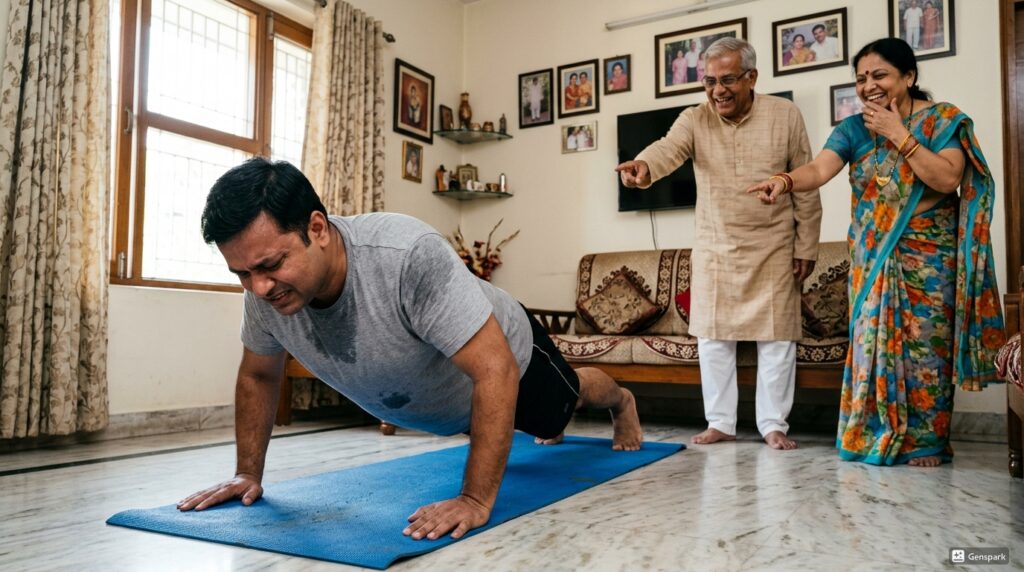

This is not a story about someone who had the perfect routine, the perfect diet, and the perfect discipline.
This is a story about someone who paid for a fitness program — and then didn’t work out for an entire month.
She was a senior professional at a large organisation. Her days started early, ended late, and left very little room for anything else. She had tried to start a routine before. It just never happened. Life kept getting in the way — meetings, fatigue, the thousand small things that pile up when you are responsible for a lot of people at work.
When she joined DashFit, she knew she needed to do something. She just couldn’t seem to take the first step.
The Month She Didn’t Start
January went by. No workouts. The app sat unused.
Most fitness programs at this point would have sent an automated reminder, maybe two, and then quietly moved on. DashFit did something different. Her health coach reached out — not with a generic message, but with a real one. He acknowledged how demanding her schedule was. He told her DashFit would work around her life, not demand she rebuild it. He offered to start with just three days a week. He said: let me be personally involved in your journey.
She replied the same morning. “Sorry I haven’t been able to even start the routine. I try but it just doesn’t happen.”
That honesty was the beginning.
They agreed on a daily check-in at 9 PM — after she got home from the office. Not a long call. Just a few minutes to plan the next day, talk through what she had done, and keep the thread alive. Once a week, a more detailed 15-minute conversation to review progress and course correct.
No rigid schedule. No guilt for missing a day. Just consistent, human accountability.
The First Morning She Worked Out
On the 5th of February, she did her first workout.
Thirty minutes. Bodyweight exercises, mobility work, neck rolls. Nothing extreme. But she logged it, she felt it, and she messaged her coach afterward: “I am beyond satisfied and happy.”
Her coach’s response? He was emotional. Because he knew what that first session represented — not thirty minutes of exercise, but the end of a month of inertia.
Within a week, her DAMS score — DashFit’s measure of activated muscle activity — was already climbing. Her coach told her: “Score is getting better. In just one day. That’s the power of compounding.”
She pushed back gently: she couldn’t do table tops properly. Her hands were too weak to hold her weight. Her coach noted it immediately, flagged it to the trainer, and swapped the exercise for a glute bridge to build toward it gradually. The plan adjusted to her — not the other way around.
When Life Hit Hard
Six weeks in, she lost her father.
There are no words for that kind of grief, and no fitness program prepares you for it. Her coach didn’t pretend otherwise. He called to check on her. He told her he was there — not as a coach, but as a person. He offered to step back entirely for as long as she needed.
She took the time she needed. And then, when she was ready, she came back.
“This came at the right time to manage myself,” she said.
Her first session back showed something remarkable. Her DAMS score returned almost immediately to where it had been before the break. Her coach told her that was muscle memory — once your body learns the movement patterns, it finds its way back faster than you’d expect.
She hadn’t lost the progress. She had only paused it.
What the Numbers Showed

Over the weeks that followed, the results compounded quietly.
She lost 3 kilograms. She looked visibly leaner — people around her started asking what she was doing differently. She fit into a dress she hadn’t been able to wear in two years. Her stamina in her Kathak dance classes improved noticeably. And her hypertension — something she had been managing for a while — came under control.
That last result is worth pausing on. Research consistently shows that structured exercise, particularly strength and resistance training, can meaningfully reduce both systolic and diastolic blood pressure. This isn’t a side effect of fitness. It’s one of the most well-documented, non-pharmacological interventions for hypertension available. For someone who had been dealing with high blood pressure, getting stronger was doing more than changing how she looked — it was changing how her body functioned.
Her DAMS score crossed 200 on a morning when she nearly didn’t work out at all. She had planned to stop at 100. She pushed herself past it and hit her personal best.
“I was wanting to do it for so long,” she said.
She renewed her subscription for three months without being asked twice.
What Made the Difference
She had everything a fitness program typically provides — a structured plan, video guidance, exercises adapted to her equipment and space. But the thing that actually moved the needle was simpler than any of that.
Someone showed up for her every morning.
Not a bot. Not an automated push notification. A health coach who remembered that Saturdays were Kathak days, who knew when she had traveled and adjusted expectations accordingly, who suggested coconut water when she felt drained and couldn’t figure out why, who told her to just do a 30-second plank on the days when doing anything more felt impossible.
“Just because it takes 30 seconds — time would not be a constraint,” he told her once, when she was exhausted after a long week. She did the plank. She logged it. The thread of consistency stayed intact.
This is what DashFit means by personalised fitness. Not a plan designed for your body type on paper. A system that adapts to your actual life — the travel, the grief, the hair spa week where you don’t want to sweat too much, the festival that kept you up all night — and keeps finding a way to move forward anyway.
For Anyone Who Paid and Hasn’t Started Yet
If you signed up for something — a gym, an app, a program — and haven’t used it, you are not unusual. You are the norm. Starting is the hardest part, and most programs are not built to help you with that specific problem.
What helped her wasn’t a better workout plan. It was someone who understood that the first step is the hardest, and stayed patient enough to wait for it — and then stayed consistent enough to keep her going once she took it.
She started in February. By March, she was hitting personal bests. By April, her blood pressure was under control and people around her were asking what she had changed.
Nothing dramatic. Just structure, accountability, and someone who didn’t give up when she almost did.
Built for discipline. Powered by data. DashFit — Performance fitness for the modern professional.
P.S. The person in discussion preferred to remain anonymous. Hence, we have not used any names in this blog. However, we got permission to share her story so that it can inspire others too.