
There is a number from a recent scientific study that stopped us in our tracks.
83%.
That is how much higher the risk of death is for people who combine abdominal obesity with low muscle mass — compared to people who have neither condition. Not marginally higher. Not slightly elevated. Eighty-three percent higher.
The study, conducted by researchers at the Federal University of São Carlos in partnership with University College London, tracked over 5,400 people across 12 years. It is one of the most comprehensive long-term studies ever conducted on this specific combination of conditions — and its conclusion is difficult to look away from.
But here is what makes it even more unsettling — and directly relevant to every urban Indian professional in their 30s and 40s reading this: this combination is not rare. It is not a distant risk. For a significant and growing portion of the Indian population, it is already happening. Quietly. Without diagnosis. And without the person having any idea.
Two Conditions. One Name. Almost No Awareness.
The medical term for this combination is sarcopenic obesity — the simultaneous presence of excess body fat and low muscle mass. Sarcopenia refers to the progressive, age-related loss of skeletal muscle. Obesity refers to excess fat accumulation, particularly around the abdomen.
On their own, each condition carries health risks. But the study revealed something that reframes the entire conversation: they do not simply add up. They amplify each other.
Excess fat intensifies inflammatory processes in the body — releasing molecules that actively accelerate muscle breakdown. At the same time, low muscle mass reduces the body’s ability to manage blood sugar, which drives further fat accumulation. Each condition makes the other worse. The result is a cycle that quietly and systematically increases the risk of cardiovascular disease, diabetes, frailty, loss of physical function — and, as the study quantifies with stark clarity, premature death.
The researchers also found something equally important: abdominal obesity alone — without muscle loss — was not associated with increased mortality risk. Neither was low muscle mass alone, which actually reduced mortality risk by 40% compared to the combined condition. It is specifically the combination that carries the danger. And muscle, specifically, is what determines how deadly excess fat actually becomes.
The Indian Context Makes This Far More Urgent

Here is where this stops being a global health statistic and becomes a specifically Indian problem.
A study of urban adults in Bengaluru found the prevalence of sarcopenic obesity at 20.6% in adults between 40 and 80 years old. The Longitudinal Ageing Study of India, which analysed data from over 72,000 older Indian adults, found that sarcopenia alone affected 41.9% of participants — and that urban residence was a significant predictor of the combined condition.
These numbers exist in older populations. But the trajectory that leads there begins decades earlier.
After the age of 30, muscle mass begins declining at roughly 0.5 to 1% per year in sedentary individuals. Muscle strength declines by 20 to 40% between the ages of 30 and 80. And Indian bodies — because of the documented thin-fat phenotype, a biological predisposition to carry more visceral fat and less skeletal muscle at any given body weight — are starting this trajectory from a more vulnerable baseline than most other populations in the world.
What this means in practice: a 35-year-old urban Indian professional with a desk job, low structured movement, and a diet heavy in refined carbohydrates may already be accumulating the exact conditions that produce sarcopenic obesity — years, possibly decades, before it becomes clinically detectable.
The scale does not tell you this. The BMI chart does not tell you this. A standard annual health check-up almost certainly does not tell you this. Because sarcopenic obesity is invisible to every measurement that tracks weight rather than what your body is actually made of.
Why the Scale Is the Wrong Tool for This Problem
This is the central issue. Most people — and most health systems — assess health through weight. You step on a scale. You calculate a BMI. If the number looks normal, you are told you are fine.
But sarcopenic obesity is specifically the condition where weight looks normal while everything underneath it is not. You can have a completely standard BMI while carrying dangerous levels of visceral fat and dangerously low skeletal muscle mass simultaneously. You can look like the picture of health on a standard medical report while your body is already running the biological programme that leads to the 83% elevated mortality risk this study identifies.
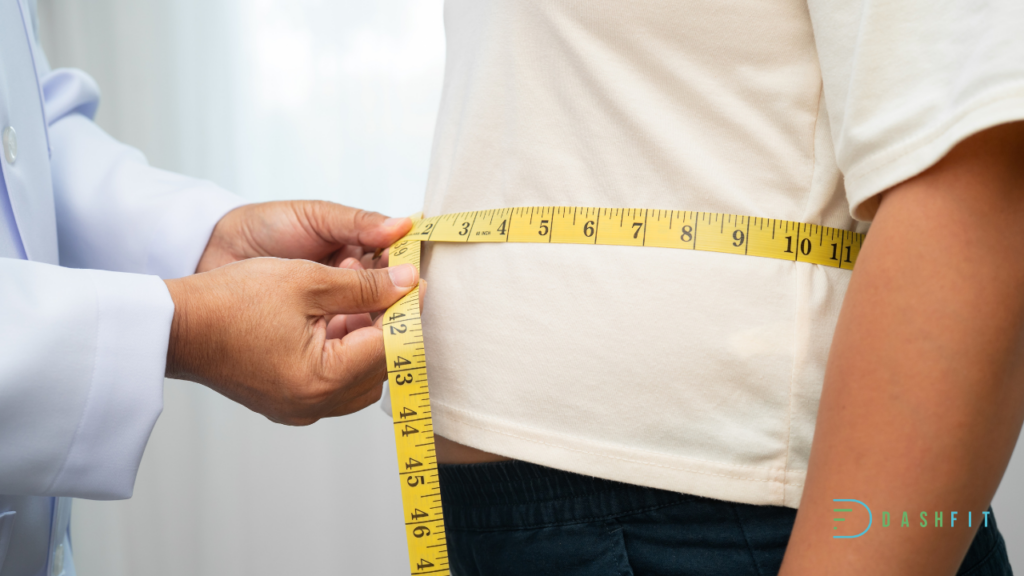
The researchers specifically noted that sarcopenic obesity is difficult to diagnose precisely because it requires complex, expensive tests — MRI, CT scans, electrical bioimpedance — that most people never access. One of their most significant findings was that simpler measures can screen for the condition without expensive equipment. For men, abdominal obesity is flagged at a waist circumference above 102 centimetres. For women, above 88 centimetres. Low muscle mass is identified by a skeletal muscle mass index below 9.36 kg/m² for men and 6.73 kg/m² for women.
These are numbers that a body composition assessment — not a weighing scale — can detect. And detecting them early is what the window of intervention is for.
What the Research Says to Do About It
The researchers are unambiguous in their conclusion. Early intervention in sarcopenic obesity requires two things: nutritional support and structured physical exercise — specifically the kind that addresses the muscle side of the equation.
Resistance and strength training provides the mechanical stimulus muscles need to maintain mass, improve function, and counteract the inflammatory processes that excess fat drives. This is not about burning calories. It is about changing what your body is composed of — fat down, muscle up — deliberately and consistently enough to break the cycle before it compounds further.
The study also reinforces something that cannot be overstated: muscle is protective. Having adequate muscle mass — even in the presence of abdominal obesity — significantly reduced mortality risk compared to having both conditions together. Building and maintaining muscle is not a cosmetic pursuit. It is, by the evidence of this research, a survival strategy.
What This Means If You Are in Your 30s or 40s

You are not 50. The study tracked people from age 50 upward because that is where the mortality data becomes measurable over a 12-year window. But the conditions that produce sarcopenic obesity — the sedentary years, the muscle loss, the visceral fat accumulation — build across the decades before that.
Your 30s and early 40s are not the aftermath of the problem. They are the window in which the problem is either being built — or prevented.
If you are spending most of your day at a desk, relying primarily on cardio when you exercise at all, eating a diet low in protein and high in carbohydrates, and measuring your health through a scale that only tracks total weight — you have no visibility into whether you are accumulating this combination of conditions right now.
A body composition assessment gives you that visibility. It tells you your skeletal muscle mass, your visceral fat levels, and how your actual body composition compares to healthy benchmarks. It is the difference between flying blind and finally having instruments.
This Is Exactly the Problem DashFit Is Built to Address

DashFit starts not with a workout plan, but with a body composition assessment — specifically because the conditions that matter most are the ones the scale cannot see.
From there, every plan is built to address both sides of the sarcopenic obesity equation: structured strength training to rebuild and protect muscle mass, and nutritional guidance to shift body composition away from visceral fat. The DAMS score tracks activated muscle activity week over week, so progress is visible and the plan adapts based on what your body is actually doing — not what a generic template assumes.
The goal is not a number on a scale. It is a body composition that keeps you functioning, metabolically healthy, and genuinely well — not just for how you feel this year, but for every decade that follows.
The 83% statistic is not a verdict. It is a warning.
And warnings are most useful when they arrive early enough to act on.
Built for discipline. Powered by data. DashFit — Performance fitness for the modern professional.