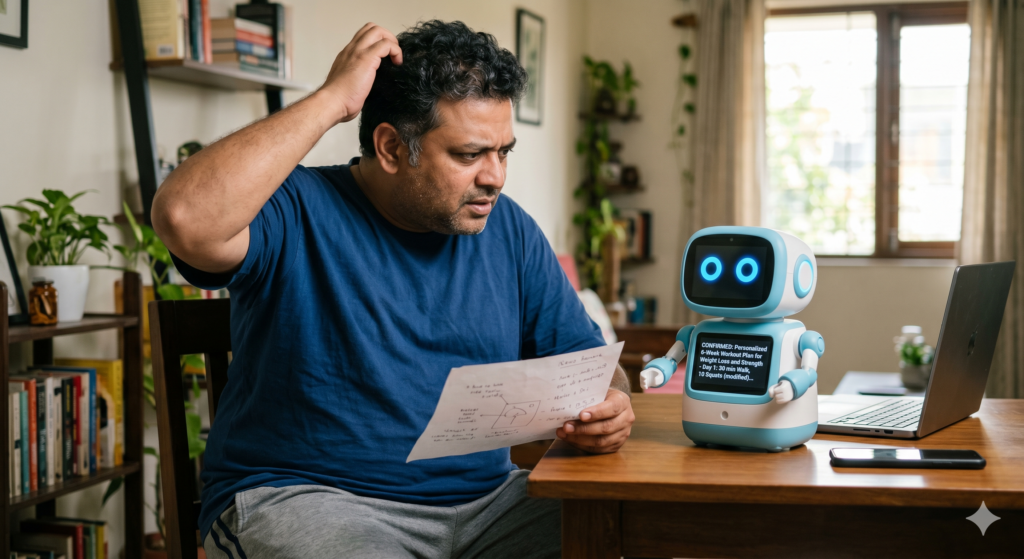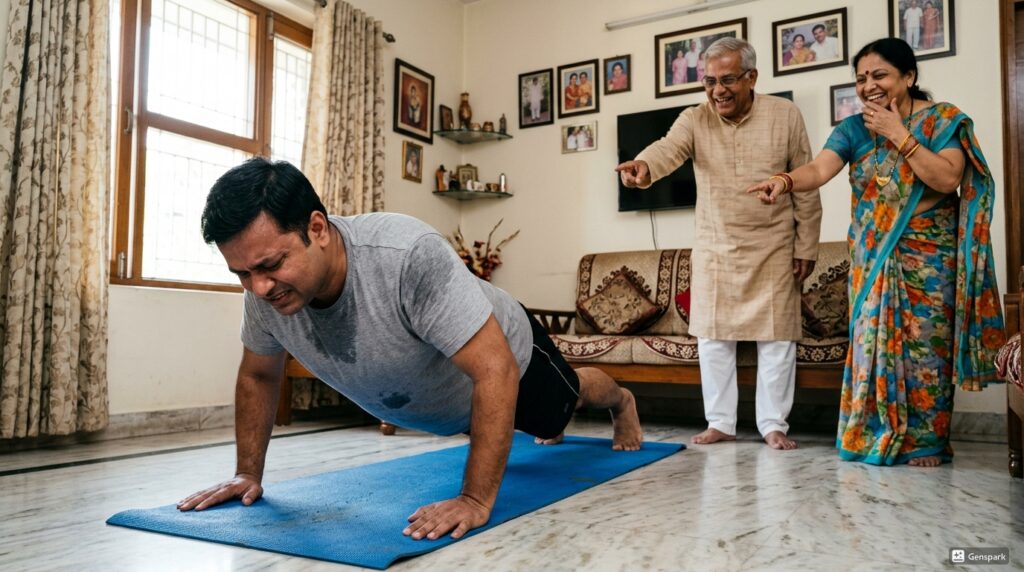
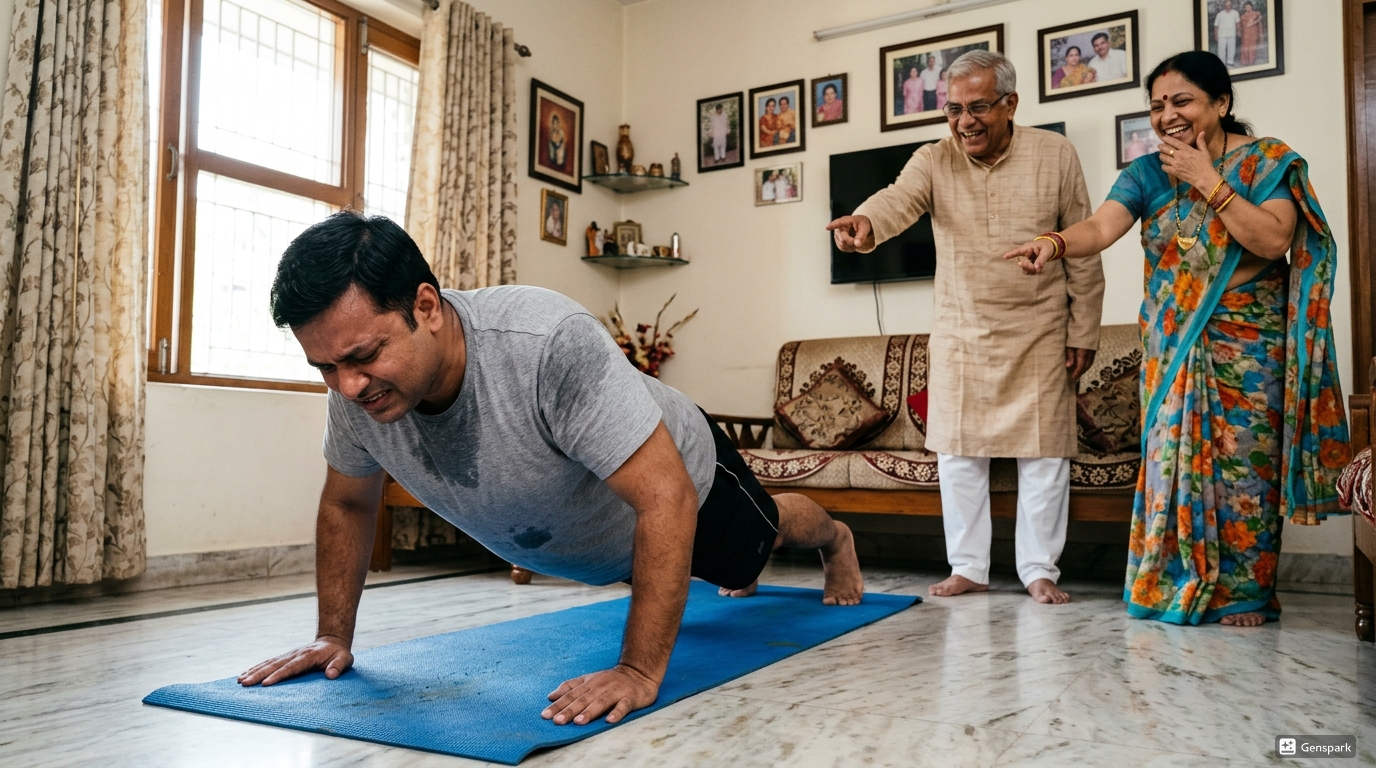
“I can’t work out this week. Guests are at my place,” said a client in his early 40s.
“Sure sir, we understand. It must be busy for you. We’ll just give you one movement to do after waking up,” our coach replied.
“No, that won’t be possible. My relatives would laugh at me. They’ll say — what nonsense are you doing?”
That statement genuinely stayed with me.
Because I’ve seen this myself too. And like many people, I had dismissed it as normal family banter. But when you sit with it long enough, something feels deeply wrong.
The Strange Arithmetic of Indian Social Approval
Think about what gets encouraged freely in an Indian gathering.
Late-night drinking. Junk food at every meal. Seconds and thirds because refusing is rude. Staying up past midnight because that is what togetherness looks like.
Nobody raises an eyebrow at any of it.
But the moment you stretch before breakfast, step away for a 20-minute workout, or say no to the third helping of mithai — suddenly you are the strange one. Suddenly there is commentary. Suddenly it is a joke at your expense.
We have collectively, somehow, arrived at a place where harming your body is socially normal and protecting it is socially awkward.
This is not just ironic. It has a cost — and that cost is being paid in orthopaedic clinics, cardiology wards, and diabetes management centres across every Indian city.
What This Mindset Is Quietly Doing to Indian Bodies
Bone and joint problems are no longer concerns reserved for older adults. Orthopaedic clinics across India are seeing a steady rise in patients aged 30 to 45 — working professionals, desk-bound employees, young parents — many of whom are genuinely surprised to learn that their joint pain is not temporary.
According to orthopaedic specialists quoted in India TV News, people in their early 30s are now presenting with joint complaints that doctors once associated with patients two decades older. The pattern in clinics has become familiar: a 35-year-old with persistent lower back pain, a 40-year-old struggling to climb stairs without knee discomfort, a 32-year-old with chronic neck stiffness that never fully settles. These are not isolated cases. They reflect sustained stress on joints that are not getting enough muscular support or recovery.
Arthritis, too, is appearing significantly earlier than previous generations experienced it. Reporting in the Hindustan Times on this trend, doctors explain that lifestyle factors — prolonged sitting, weak stabiliser muscles, chronic stress, poor nutrition — are accelerating joint degeneration in ways that were previously unheard of in this age group.
The medical reality is straightforward: peak bone mass is achieved by the late 20s. After that, bone and joint health depend entirely on maintenance. And for a generation of Indian professionals spending 8 to 10 hours a day at a desk, whose primary social occasions involve food and alcohol rather than movement, that maintenance is not happening.
The Peer Pressure Nobody Talks About in Fitness
We talk extensively about peer pressure in the context of teenagers making poor choices. We rarely talk about it in the context of adults making poor health choices — even though it operates exactly the same way.
When your family encourages overeating and mocks exercise, the pressure is real. It is subtle, it is social, and it is persistent. And for Indian millennials who already struggle with guilt, obligation, and the weight of family opinion, it can be the deciding factor between maintaining a healthy habit and abandoning it.
The client who told us his relatives would laugh — he did not skip his workout because he was lazy. He skipped it because the social cost of doing it felt higher than the physical cost of not doing it. That calculus, repeated across enough weeks and months, is how people who genuinely want to be healthier end up not being healthier.
And the relatives who laughed will not be there when the back pain arrives. They will not sit with him through the physiotherapy appointments. They will not feel the stiffness when he gets out of bed on a cold morning at 48. They will not carry his diagnosis.
He will. Alone.
Why Gen Z Gets This Better Than Millennials Do
There is something genuinely interesting happening with the generation that came after millennials.
Gen Z, for all the criticism directed at them, seems significantly more comfortable drawing boundaries around their health. They are more likely to decline alcohol without lengthy explanations, to step away from a social gathering for a workout without apologising for it, to say no to food they do not want without performing elaborate excuses. They treat their health as a personal matter that does not require social validation.
Millennials, raised in a culture where collective opinion carries enormous weight and individual choices are regularly discussed as group business, often find this harder. The need to not stand out, to not invite commentary, to not be the one who is “too much” — it runs deep.
But here is the thing worth borrowing from the generation behind us: your body does not care about social approval. It keeps score of every compromise you made to avoid looking weird. And by the time that score becomes impossible to ignore — by the time the back pain is chronic, the blood sugar is high, the joints are stiff every morning — the people whose opinions you managed around will have moved on to other conversations.
What Needs to Change — As Individuals and As a Society
This is not just a personal problem. It is a cultural one. And cultural problems require cultural shifts.
We need to encourage movement instead of mocking it. Even banter that feels harmless discourages consistency. The client who skips a workout because of what his relatives might say is not a weak person — he is responding rationally to a social environment that has made health feel embarrassing. Changing that environment starts with the small moments: not making the joke, or better, actively encouraging the person who is trying.
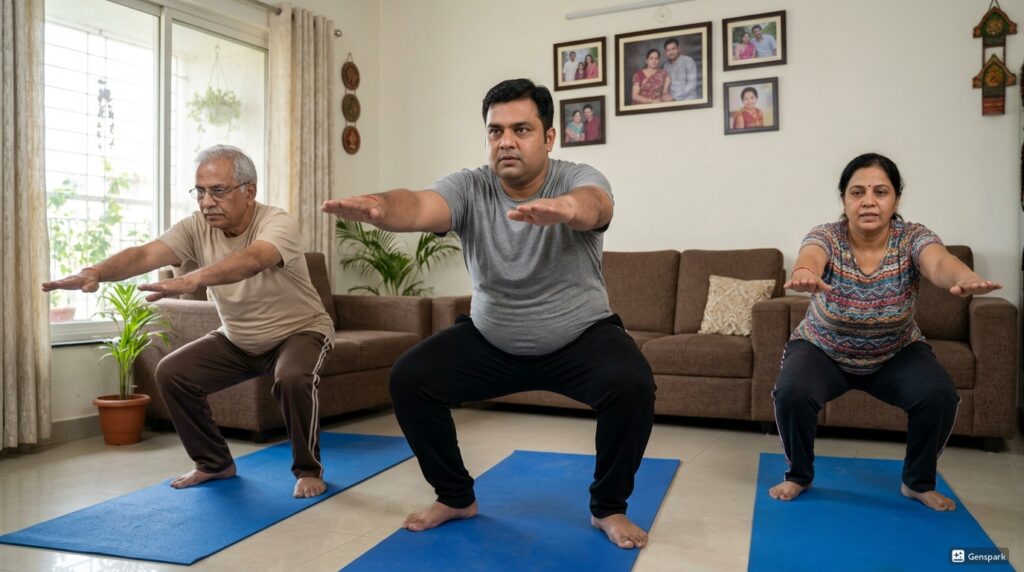
We need to normalise movement as part of everyday life. The best thing you can do for your body should never feel socially awkward. A stretch after waking up, a walk after dinner, a 20-minute workout before the day begins — these should be as unremarkable as brushing your teeth. They are not extreme. They are basic maintenance.
We need to stop self-diagnosing and start taking expert guidance. One of the most common patterns we see is people who have been managing pain, stiffness, or fatigue for months — taking advice from Google, from well-meaning relatives, from the internet — before ever consulting someone who actually understands what their body needs. By the time they arrive at a structured programme, the damage has been building quietly for a long time.
The Body Always Keeps Score
There is a version of this story that ends well — and a version that does not.
The version that ends well looks like the client who ignored his relatives, did his one morning movement anyway, kept the thread of consistency alive, and arrived at his 50s with a body that still works the way it should. Stronger than most people his age. Mobile. Energetic. Able to do the things he loves without pain managing every decision.
The version that does not end well looks like every person who let the social friction win — who made the compromise again and again until the compromises became the default — and who is now managing a body that accumulated years of neglect while he was busy not looking weird at family gatherings.
Your relatives will not feel your back pain. They will not carry your diabetes or your stiffness or your fatigue. They will not be there for the physiotherapy, the sleepless nights, the slow loss of the things you used to be able to do without thinking.
You will. And that is reason enough to stop letting their momentary judgement matter more than your long-term health.
What DashFit Is Built Around
DashFit exists for the person who is trying — often against social friction, often without the right guidance, often in the gaps of a life that does not cooperate. We know that getting started is not the hard part. Staying consistent through a real, unpredictable life — full of guests and relatives and festivals and guilt — is the hard part.
That is why DashFit pairs every client with a health coach who checks in daily, adapts the plan when life changes shape, and never asks you to choose between your health and your life. Even on the day the relatives are visiting, there is always something — even one movement, even 30 seconds — that keeps the thread alive.
Because consistency, however imperfect, always beats the perfect routine you abandoned.
Built for discipline. Powered by data. DashFit — Performance fitness for the modern professional.